place cards
Wedding Name Tags vs. Place Cards: Which Do You Actually Need?
Wedding Name Tags vs. Place Cards: Which Do You Actually Need?
Somewhere in your planning, someone said the words "wedding name tags," and now you're wondering if you've missed a whole category of thing you were supposed to order.
Take a deep breath. You probably haven't.
Here's the confusion, and it's a fair one: "wedding name tags," "name cards," "place cards," and "escort cards" get used interchangeably online. They are not the same thing. They solve different problems, they sit in different places, and most weddings only need one or two of them.
Let's sort it out in about four minutes.
The Four Things People Mean
Escort cards
These live at the entrance. Each one has a guest's name and a table number. Guests pick up their card on the way in and it "escorts" them to the right table.
They don't say which seat — just which table.
Place cards
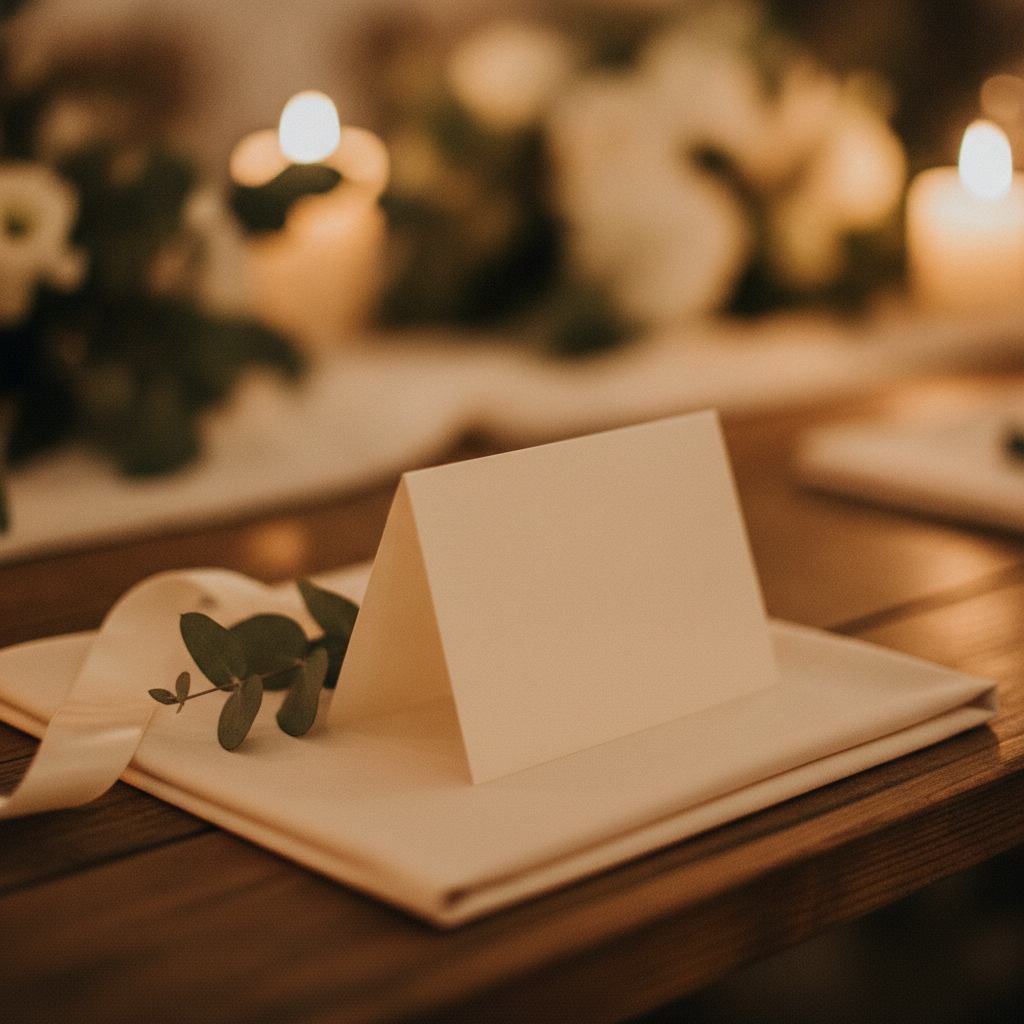
These live on the table, at the individual place setting. Each one has one guest's name, sitting at the exact spot where that person sits.
Escort card gets you to table nine. Place card tells you which chair at table nine.
A seating chart display
One large printed board at the entrance listing every guest and their table. It replaces escort cards entirely — one sign instead of 140 little cards.
Wedding name tags
Actual wearable tags — a sticker, a pin, or a badge with a guest's name on it. Guests wear them so other guests know who they are.
That last one is the one worth talking about, because it's the one most people are unsure about.
Do You Need Wedding Name Tags?
Here is the truth: for the large majority of weddings, no.
Wearable name tags read as conference, not celebration. They photograph poorly. They fall off. And they quietly signal to your guests that you didn't expect them to know each other — which lands a little strangely at a wedding.
There are real exceptions, though. Name tags genuinely help when:
- Two large families are meeting for the first time. If neither side knows anyone from the other, tags can break the ice fast.
- It's a destination wedding with a multi-day schedule. Welcome dinners and day-before events are where tags earn their keep, not the reception itself.
- You're having a very large wedding — 250-plus — where even the couple can't name everyone.
Even in those cases, most couples use them at the welcome event, not at the reception.
Your action: ask yourself one question. Will a typical guest at your reception be sitting near at least one person they already know? If yes, skip name tags. Your seating chart is already doing that job.
What Guests Actually Want
We hear the same thing from couples after the wedding, and it's never about tags.
Guests want to know three things when they walk in:
- Where do I sit?
- Is my name spelled right?
- Did anyone remember I don't eat meat?
That's it. Those are the three anxieties in the first ten minutes of a reception, and place cards handle all three at once.
A guest who finds a card with their name spelled correctly at a specific seat feels expected. That's a small thing that does a surprising amount of work. It's the difference between arriving at a party and arriving somewhere you belong.
Name tags don't do that. Place cards do.
So What Combination Should You Order?
Most receptions land in one of three setups.
Setup A — Seating chart board + place cards
The most common, and the one we'd point most brides toward.
One printed board at the entrance sends everyone to the right table. Place cards on each table settle the individual seats. No cards to alphabetize at the entry table, no wind blowing them off a display, and one clean focal point when guests walk in.
Best for: plated dinners, most receptions between 60 and 200 guests, and anyone who wants fewer moving parts on the day.
Setup B — Escort cards + place cards
The traditional formal version. A table of individual escort cards at the entrance, then place cards at each seat.
It looks lovely and gives you a display moment. It's also more work: cards must be alphabetized, laid out, and watched. If you're outdoors, they need something to weigh them down.
Best for: formal weddings, indoor venues, and couples who want the escort card display as a design element.
Setup C — Seating chart board only
Guests find their table and choose any open seat within it.
Simpler and less to print. The trade-off: your caterer loses per-seat meal tracking, and guests do a small awkward shuffle at each table deciding where to land.
Best for: buffet or family-style service, casual receptions, and smaller guest counts.
Notice what's not on this list: wearable name tags. They're an add-on for a specific situation, not part of the core setup.
Getting the Names Right
Whichever setup you pick, the names themselves are where the real risk sits.
A few things worth being careful about:
Spelling. Pull names from RSVPs, not memory. "Cathy" and "Kathy" both look correct until the wrong one is sitting in front of the wrong person.
Titles. Decide on one convention and hold it for everyone. Either full formal titles across the board, or first and last names across the board. Mixing them looks like an oversight.
Plus-ones. Get the actual name. "Guest of Michael Reed" on a card is the fastest way to make someone feel like an afterthought. If the RSVP didn't capture it, ask.
Nicknames. Use what the person actually goes by. Your uncle who has been "Bud" for fifty years does not want to find "Raymond" at his seat.
If you want the full breakdown on wording, sizing, and display, our complete guide to wedding place cards covers all of it in one place.
The Order That Saves You Rework
Sequence matters here more than anything else.
1. Close RSVPs. Nothing gets printed before this.
2. Build the seating chart. You can't print place cards without knowing who sits where. The free seating chart tool handles the layout and gives you an export you can hand straight to your printer and your caterer.
3. Verify the name list. Read it out loud. Spelling errors hide from your eyes but not from your ears.
4. Order your printed pieces. Seating chart board and place cards together, from the same finalized list.
5. Leave a buffer. Order a handful of blank extras for late changes. There are always one or two.
The benefit of this order: you print once. Most of the reprint stories we hear come from someone ordering cards before the seating was actually settled.
FAQ
What's the difference between escort cards and place cards? Escort cards sit at the entrance and tell a guest which table to go to. Place cards sit on the table at a specific setting and tell that guest which seat is theirs. Many formal weddings use both; many modern weddings replace escort cards with one large seating chart board.
Are wedding name tags tacky? Not inherently — but they read as corporate at a reception, and they rarely photograph well. They work best at multi-day or destination weddings where guests genuinely don't know each other yet. For a standard reception, a seating chart and place cards do the job more elegantly.
Do I need place cards if I have a seating chart board? Only for assigned seats. If you're assigning guests to tables but letting them pick their own chair, the board alone is enough. If you're serving a plated dinner with meal selections, place cards make service much smoother.
When should I order place cards? About three to four weeks before the wedding, once RSVPs have closed and your seating is settled. Order a few blanks alongside them for the late changes that always arrive.
Keep It Simple
You do not need four kinds of cards. Most weddings need a seating chart display and a set of place cards, and that's the whole system.
Limiting your choices here saves real mental energy for the decisions that actually change how the day feels.
When your list is ready, our shop prints custom name place cards and seating chart foam boards from the names you've already finalized — no design software, no back-and-forth proofs.
Not sure which setup fits your reception? Send us a note and describe your dinner service and guest count. We'll tell you straight what you actually need — and what you can skip.
Pick one, order it, and move on.