church pews
How Much Does a Church Pew Weigh?
How Much Does a Church Pew Weigh?
It's a strange thing to wonder about while planning a wedding. But if you've ever tried to shift one an inch on a hardwood floor, you already know the answer in your gut: a lot.
Take a deep breath. This isn't a trick question, and you don't need to become a furniture expert to plan your ceremony seating. Here's the real answer, what changes it, and why it matters more than you'd think.
The Short Answer
A standard 8-foot solid hardwood church pew weighs somewhere between 250 and 400 pounds. Some run heavier. A few run lighter. But that's the range you should plan around.
For comparison, a single wooden folding chair weighs about 8 to 12 pounds. One pew replaces a whole row of chairs — and weighs roughly as much as 25 to 30 of them combined.
That number isn't trivia. It's the whole reason pew setup works the way it does.
The good news? That weight was never an accident. Church pews were built to last generations inside a sanctuary, not to get folded up and stacked in a closet between Sundays. The same density that makes them heavy to lift is what makes them feel steady the moment a guest sits down — no creak, no wobble, no plastic flex underfoot. Heavy, in this case, is a feature.
What Actually Changes the Weight
Not all pews are built the same. Three things move the number up or down.
Wood Type
Oak, maple, and other dense hardwoods weigh more than pine or softer woods. A pew built from solid oak sits at the heavy end of the range. It's also the reason those pews have survived decades of church services without warping or wobbling.
Length
Weight scales with length, roughly linearly. An 8-foot pew and a 12-foot pew aren't close. The longer the row, the more hands you need to move it.
Construction
Here's the detail most people miss: solid pews and frame-built pews are not the same animal. A solid hardwood pew is one dense, continuous structure — heavy, but also sturdy enough that it won't flex or creak under a full row of guests. A lighter, frame-and-panel pew trades some of that weight for hollow space inside. It's easier to carry. It's also easier to feel unstable when six people sit down at once.
The benefit of solid construction: it holds its shape, holds its guests, and holds up outdoors on grass or gravel without shifting.
Why the Weight Matters for Your Wedding
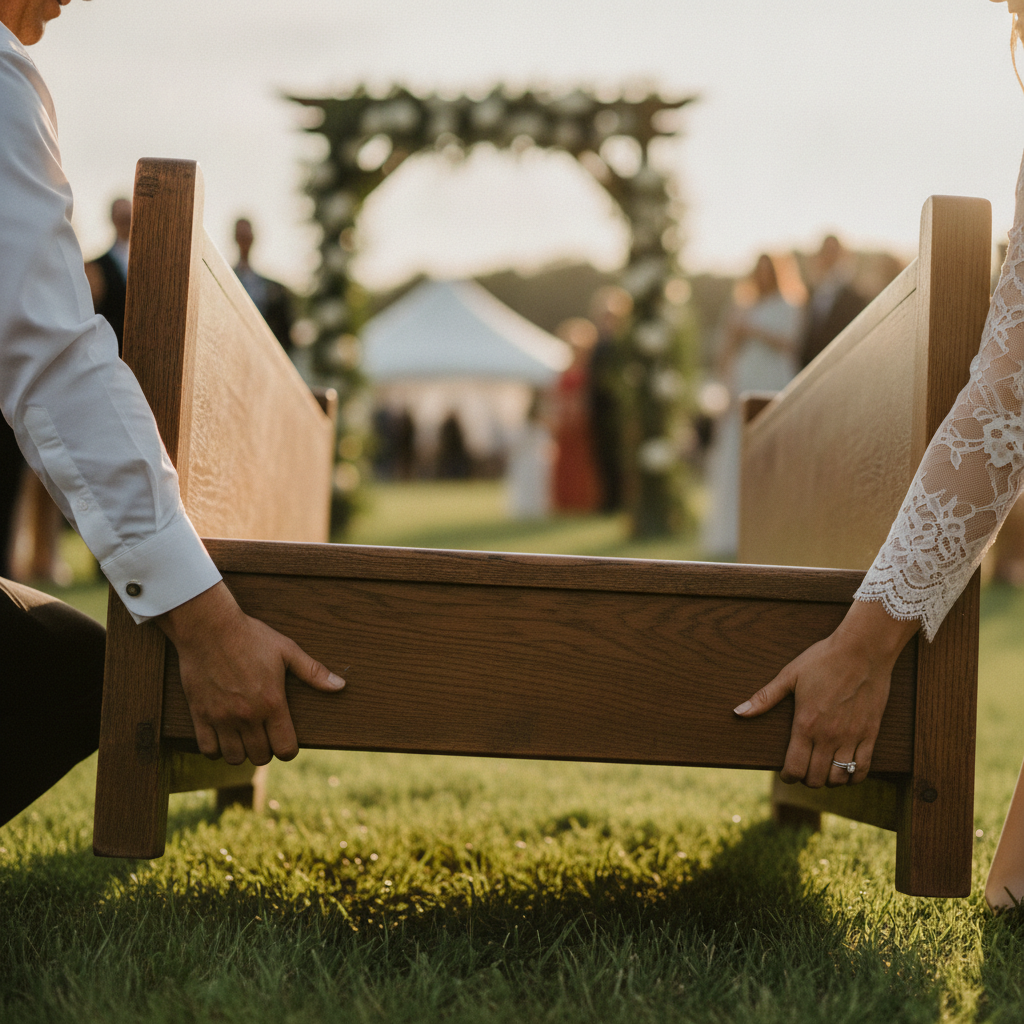
Here is the truth: a 300-pound bench isn't something you, your fiancé, or your wedding party should be wrestling into place the morning of your ceremony.
A few reasons the weight actually matters:
- It takes real people, not good intentions. Moving one pew safely usually takes two to four people. Moving a full row for an outdoor ceremony is not a five-minute job — it's labor, and it's the kind that can throw out a back the day before you walk down the aisle.
- Floors and lawns react differently to that much weight. Solid hardwood on a hardwood venue floor can scuff or scratch if it's dragged instead of lifted. On grass, uneven weight distribution means a pew that isn't level — wobbly seating for your guests.
- Rented trucks and borrowed trailers aren't built for this. Hauling several hundred pounds of hardwood safely takes the right vehicle and the right straps. This is not a minivan job.
None of this is meant to scare you off pews. It's the opposite — it's exactly why you shouldn't be the one handling any of it.
What It Actually Takes to Move One
Here's how it breaks down in practice. A single 8-foot solid hardwood pew generally needs:
- Two to four people, positioned at each end and, for longer pews, along the middle.
- A flat dolly or furniture straps for anything moved across a parking lot or gravel drive — carrying it bare-handed the whole distance isn't realistic.
- A pickup truck or box trailer, not a hatchback. Several pews stacked together can run into the thousands of pounds.
- A plan for the ground itself. Grass that's soft from rain, gravel that shifts, or a sloped lawn all change how carefully a pew needs to be set down.
None of that is meant as a warning to avoid pews. It's context for why "just borrow some pews and move them yourself" sounds simpler than it actually is.
Buying a Pew vs. Renting One — Where the Weight Bites
Some brides find a set of antique pews for sale online and think about buying instead of renting. It's a reasonable instinct. But the weight is exactly where that plan usually runs into trouble.
Buying means you own the transport problem, too. You're coordinating a truck, enough people to load and unload safely, and a place to store several hundred pounds of hardwood before and after your one-day ceremony. And if a pew gets scratched or nicked in transit, it's your loss, not a rental company's.
Renting flips that. The pew shows up already accounted for — the truck, the crew, the straps, the plan for your specific venue's ground and floors. You get the exact same solid hardwood pew, minus the logistics that come with the weight.
How Howard Wedding Rentals Handles the Heavy Lifting
This is the part that should lower your shoulders a little: with our church pew rental service, delivery, placement, and teardown are already included. You don't rent a heavy piece of furniture and then figure out logistics on your own.
Our team brings the pews to your venue, sets them exactly where you want your ceremony to happen, and comes back to remove them when the day is done. Solid hardwood, professionally handled, without a single pew ever touching your to-do list.
Your action: pick your ceremony date and venue, and let us take the weight — literally — off your hands.
Pew vs. Chairs — Does the Weight Change the Decision?
Short answer: no, and here's why. The weight of a pew is a setup consideration, not a choosing consideration. Once delivery and placement are handled for you, a pew behaves exactly like the elegant, no-wobble seating it was designed to be — no different in your experience than a folding chair, except sturdier and far more photogenic.
If you're still comparing the two, our guide on what a church pew actually is breaks down the full comparison — capacity, feel, and why more couples are skipping folding chairs altogether.
FAQ
Can one person move a church pew alone? Not safely. Even a smaller pew is built for two to four people to lift and carry. Don't try to muscle one on your own.
Will a heavy pew damage my venue's floor? It can, if it's dragged. Lifted and set down carefully — which is exactly how a professional delivery team handles it — a solid hardwood pew is safe on any venue floor.
Are pews too heavy for an outdoor ceremony on grass? Not at all. Solid hardwood pews are actually a better outdoor choice than lightweight chairs, which tip and sink into soft ground. The weight that makes them hard to carry is the same weight that keeps them steady once they're placed.
How many pews does a typical ceremony need? That depends on your guest count and how many you seat per row — most standard pews comfortably seat around 5–6 adults. If you're still mapping out your layout, our free seating chart tool makes it easy to plan the whole room, ceremony seating included.
Is it cheaper to buy pews than rent them? On paper, sometimes. Once you account for transport, extra hands to move them, and storage for something you'll use once, renting usually comes out ahead — especially when delivery and teardown are already part of the price.
The Bottom Line
A church pew weighs enough that you should never plan on moving one yourself. But that's not a reason to skip them — it's a reason to let the delivery be someone else's job.
Reach out and tell us about your date. We'll handle everything from the truck to the teardown, so the only thing you have to carry down the aisle is yourself.